Ten days. Fifty-four nations. One estate in the western Catskills.
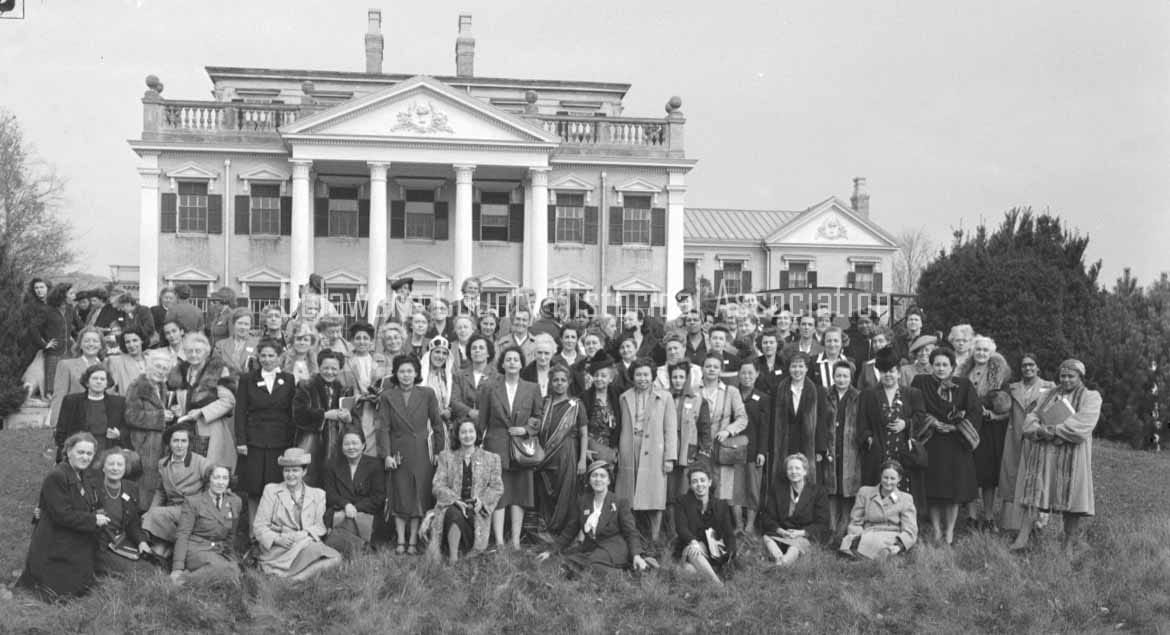
International Assembly of Women · Ashridge Farm South Kortright, New York · October 20, 1946 Photograph by Bob Wyer · Delaware County Historical Association
An Account
The International Assembly of Women
I
The Invitation
The Invitation
In the first week of October 1946, the war had been over for thirteen months and the world was still not at peace. The Nuremberg verdicts had come down at the start of the month. The United Nations was less than a year old and had not yet found a permanent home. The United States and the Soviet Union, until recently allies, were already speaking past one another about what should be done with the atomic bomb.
It was in that week that Alice Throckmorton McLean sent the last of her invitations and prepared the house at Ashridge to receive the world.
McLean was sixty years old, daughter of the copper magnate James McLean, and the founder of the American Women's Voluntary Services — the largest civilian women's organization in American history. At its wartime height the AWVS counted three hundred and twenty-five thousand members, trained in everything from ambulance driving to cryptography to firefighting, and explicitly open to women of every race and faith at a time when nothing else of its size was. McLean had spent the war years running it from her father's old estate in South Kortright, New York, a thousand-acre farm in the western Catskills, and she had spent much of her own fortune to keep it running when federal funding did not arrive.
By the autumn of 1946 the AWVS was winding down. McLean was turning her attention to what she had been calling, for several years, the International Valley — a project to use her land and her connections to bring women from around the world together in the service of peace and the arts. The International Assembly of Women was the first, and as it turned out the only, formal expression of that idea.
The conference was co-sponsored by Eleanor Roosevelt, then in her second year as a United States delegate to the United Nations and, since April, the chair of the new UN Commission on Human Rights. The two women had known one another for years through the overlapping circles of New York philanthropy and wartime civic work. Mrs. Roosevelt was already drafting, with a small international committee, what would become the Universal Declaration of Human Rights. She would come to South Kortright at the end of the ten days to give the closing address.
The Assembly's working purpose, as McLean described it to the press in early October, was to gather women from the largest possible number of nations to discuss the political, economic, social, and spiritual problems of the post-war world, and to send their findings to the United Nations. Twenty women's organizations were involved in convening it. About fifty American delegates were expected. About one hundred and forty would come from abroad.
The list of nations represented eventually reached fifty-four. The list of women who had been refused passage, or whose papers had not come through in time, was longer than that.
II
The Delegates
The Delegates
Most of the delegates arrived in New York in the second week of October and were brought by train and car up the Hudson Valley, then west through the Catskills to South Kortright. The drive in those days went over the Rip Van Winkle Bridge at Hudson and on through a country the river valley had carved out over millennia. Eleanor Roosevelt, who made the same drive a week later from Hyde Park, called the colors on the slopes "as beautiful as any I have ever seen."
The delegates came from places the war had broken in different ways and from places it had not reached at all. There were women from France, the Netherlands, Norway, Denmark, and Belgium. There were women from China and the Philippines, from India and from a Korea still under American military government. There were women from Mexico and from a handful of Latin American republics, from Australia, from the new states of the Middle East. There was a delegate from Germany, said to have been the first German woman granted an American visa after the war. There was a delegate from France whose papers were nearly denied over her political associations and who was admitted only after a final intervention from Washington. There were no delegates from the Soviet Union.
Most of the delegates wore their national dress when the formal sessions opened. The photographs that survive show a kind of visual diplomacy that no later international meeting would quite manage again — the saris next to the brocade jackets next to the wool suits of the American organizers, the head coverings of half a dozen traditions arranged in rows on the lawn in front of the house.
We do not have a complete roster. Such a list, if it was ever compiled centrally, has not survived in the public record. What we have are scattered references in newspapers, in Eleanor Roosevelt's My Day columns, in the scrapbook held by the Stamford Village Library and the photographs held by the Delaware County Historical Association. Among the named participants:
Mrs. Edward C. Carter — born Alice Olin Draper — chaired the steering committee. Her husband, Edward Clark Carter, was Secretary General of the Institute of Pacific Relations, the leading American forum for dialogue with East and Southeast Asia. Mrs. Carter brought to the steering committee a deep network of women working in international affairs at a moment when very few women were.
Katharine Lenroot, third Chief of the United States Children's Bureau, who had recently helped found what would become UNICEF, spoke on standards of child care. Eleanor Roosevelt heard her address on the conference's penultimate Sunday and remarked on it in her column the following Tuesday.
Elinor Morgenthau, longtime friend of Mrs. Roosevelt and the wife of Henry Morgenthau Jr., the former Treasury Secretary, drove out from Hyde Park with her to the closing weekend.
The full list of women who attended, based on the organizations represented and on the patterns of the period, is long and worth recovering. We are working with the Delaware County Historical Association and the Stamford Village Library to compile what can be compiled. We will name them on this site as we find them.
The organizations behind the Assembly are easier to trace. They included the American Women's Voluntary Services itself, the International Council of Women and the International Alliance of Women — both of which had survived the war and were reorganizing — the Women's International League for Peace and Freedom, the Congress of American Women, the United States Children's Bureau, and a constellation of national groups from the represented countries. Several of the women in attendance would within a year be appointed to the UN Commission on the Status of Women, established in mid-1946 as a subcommission of Roosevelt's Human Rights Commission and elevated to full commission status the following summer.
The Assembly was, in other words, not a gathering of amateurs. It was a working meeting of the women who were, at that moment, building the post-war international order's slender provision for women's voices.
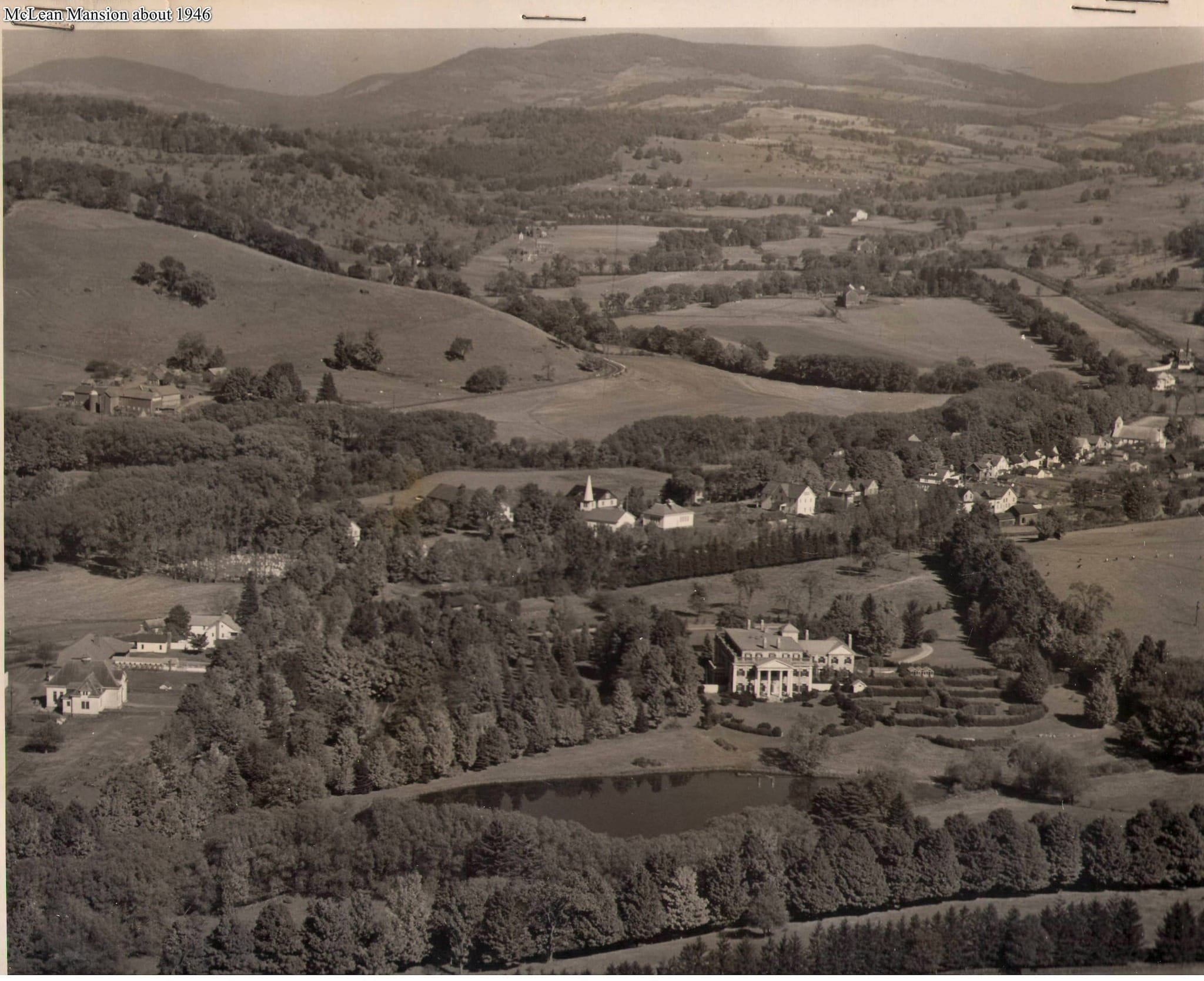
The McLean estate and the village of South Kortright, c. 1946.
Photographer unknown · Delaware County Historical Association.
III
The Days
The Days
The first formal gathering was a Sunday morning service on October 13 at St. Peter's Episcopal Church in Hobart, the small mill town three miles up the river. The delegates sat together with local residents in a church that had been serving the West Branch valley since the middle of the nineteenth century. After the service they returned to Ashridge for the first afternoon assembly, held in the coach house across the lane from the main mansion.
The opening business was conducted by Mrs. Carter, and her remarks have come down to us through a New York Times dispatch published the following morning. They are perhaps the most quoted passages of the entire Assembly, and they are quoted because they capture, better than anything more formal could, the particular character of the gathering. Mrs. Carter said, in substance:
No smoking in the coach house — there is hay above.
Go easy on the soap; we haven't a great deal.
There is a shortage of help, so laundry will be difficult.
You may have to eat on paper plates and use paper towels.
Those of you staying in the village will need to make your own beds.
Mrs. McLean is serving up to the women of the world her farm's choicest food, including turkey, ham, butter, cream, vegetables, maple syrup, and four steers which she recently slaughtered.
Mrs. Edward C. Carter · Opening remarks · October 13, 1946
Reported in the New York Times, October 14, 1946
It is hard to read these instructions today without registering several things at once. That the post-war shortages were still real, even in upstate New York. That an American hostess of significant means was unembarrassed to acknowledge those shortages to a gathering of foreign dignitaries. That the meal at the heart of a ten-day international conference on world peace would consist of what the host's own farm had been able to grow and slaughter. And that the women being addressed — including women from nations where bread was still rationed — would have understood and respected each of these facts as a matter of course.
It is also hard not to read them as a kind of accidental manifesto. The Assembly was not a state event. It had no government funding, no diplomatic protocol, no permanent secretariat. It was women, in a coach house, on a farm, eating what the farm had grown, talking about how to keep the world from falling apart again.
The Assembly's working sessions took place over the next eight days. Some were held in the coach house. Others were held at South Kortright Central School and at Stamford Central School, a few miles to the east, where local women and high school students attended in numbers. The format was the roundtable: delegates broke into smaller groups by subject — child welfare, refugee aid, women's legal status, food security, education, the role of women in the new United Nations — and met repeatedly across the week to produce position papers that would be consolidated at the end.
The American household staff at the mansion, even with the help of local women who had volunteered, was not large enough to host two hundred guests in the manner the Gilded Age house had been built for. Some delegates stayed at the mansion. Many were housed at inns and farmhouses up and down the West Branch valley — in Hobart, South Kortright, Stamford, and Bloomville — and were driven back and forth each day in a fleet of borrowed cars. Among those lodging houses was the Greek Revival farmhouse on the river road three miles from the mansion, built in 1890 and known in the 1940s as the Mansion Inn. It is now part of Ashridge again.
The Catskill autumn cooperated: the colors held through the week, and the photographs that survive show the lawns dry and the women in light coats.
IV
The Closing
The Closing
Mrs. Roosevelt arrived on Sunday, October 20, the Assembly's final day. She drove out from Hyde Park that morning with Elinor Morgenthau. They came in time to hear Miss Lenroot's address on child care standards, and Mrs. Roosevelt took notes through it; she would reference the talk in the My Day column she filed three days later.
The closing assembly was held that afternoon in the coach house. The room had been arranged with the chairs facing forward for a single formal session. Mrs. Roosevelt's address has not, to our knowledge, survived in full — the partial accounts in the New York Times and in her own column emphasize one passage, which she repeated in slightly different forms several times that autumn: that the findings of the Assembly were to be transmitted to the United Nations General Assembly, then convening for its second session in New York, and that the women in attendance had a particular obligation to keep the cause of peace before the eyes of the world's governments now that the war had ended.
The phrase she used about the Assembly's purpose — the women of so many nations have an interest in the establishment of peace — was the line the wire services picked up.
After the formal session, Mrs. Roosevelt and Mrs. McLean walked together to the front steps of the mansion, where a larger crowd had gathered. Delegates, local residents from South Kortright and the surrounding towns, students from the two schools, photographers from the wire services and from the local press. Bob Wyer, the Delaware County photographer who had been documenting the Assembly through the week, made his now-best-known image at this moment: Mrs. McLean and Mrs. Roosevelt on the steps of the mansion, the delegates in their national dress arranged in rows below.
Mrs. Roosevelt spoke again, briefly and more informally, from the steps. She thanked Mrs. McLean. She thanked the delegates. She thanked the women of the surrounding towns who had cooked, driven, washed, housed, and translated through the ten days, and without whom the Assembly could not have happened. Then the gathering broke for the evening.
The day closed with fireworks over the lawn.
V
What Followed
What Followed
The delegates did not all leave on Monday morning. Many stayed in the United States for another week, on an itinerary McLean and Roosevelt had arranged together. They went to Hyde Park to see the Roosevelt home. They took tea at Vassar College in Poughkeepsie. They went to Hartford to meet with the women's organizations of Connecticut. They convened again in New York City at the Waldorf, and again at the Cosmopolitan Club for tea hosted by McCall's magazine. They toured Philadelphia. Then they went home.
The Assembly's findings were transmitted to the United Nations as Mrs. Roosevelt had insisted they would be. They became part of the documentary record that the new Commission on the Status of Women would draw on through its first sessions in early 1947 at Lake Success, where Bodil Begtrup of Denmark, then chairing the Subcommission, would request that the Economic and Social Council elevate it to a full commission — a request granted that summer.
The longer arc is now well known. Mrs. Roosevelt would chair the Human Rights Commission through 1948 and would preside, on December 10 of that year, over the United Nations General Assembly's adoption of the Universal Declaration of Human Rights. Hansa Mehta of India would insist, against opposition, that Article 1's "all men are born free and equal" be amended to "all human beings are born free and equal." The phrase that resulted is now read in more than five hundred languages and dialects.
It is impossible to say what specific weight the South Kortright Assembly carried in the year between October 1946 and December 1948. What we can say is that the women who came to Ashridge were the women who were doing this work. They were the same women, in many cases by name, who would sit at the Lake Success table the following winter and the Paris drafting table the year after that. The Assembly at Ashridge was a private, philanthropically funded gathering in the western Catskills, but its participants were the network the post-war international order's slender provision for women's voices would run through.
Alice McLean continued to work the estate after the Assembly. In July 1948 she founded the International Valley Foundation and opened a multidisciplinary cultural program on the grounds: a writers' center under the New York editor Vieva Dawley Smith, a music center under the Hungarian-born singer Elizabeth Alexander Major, a painting program, and — in McLean's own drawing room — an exhibition of seventy contemporary Chinese paintings from thirty artists, brought to the United States at the request of the Chinese Government and bound that autumn for the Metropolitan Museum of Art. The opening salon drew the novelist Fannie Hurst and the Chinese Consul General. In October of the same year, the actor Will Geer brought the full Broadway cast of Harvest Festival — a Mark Twain evening of folk songs and spirituals — to the Carriage House. Three years later he would be blacklisted.
How long McLean stayed in residence after the foundation's first season is not yet clear to us. She died in 1968, at eighty-two, in the same year the Universal Declaration of Human Rights celebrated its twentieth anniversary. She does not appear in most general histories of the period. The American Women's Voluntary Services, which she founded and ran for most of a decade and which trained a third of a million American women in the work of civilian defense, is mentioned in passing in the better wartime studies and not at all in many. The International Assembly of Women does not appear in most.
This site exists in part to correct that.
VI
The House Now
The House Now
The mansion that received the delegates in October 1946 had been built between 1912 and 1914 by James McLean, a copper baron whose fortune came through Phelps-Dodge. He gave it a copper roof, of course. The roof is still there. It has been weathering for one hundred and twelve years, and the bright metal of 1912 is now the patinated green of an oxidized centenary — the same color the women in their national dress would have seen above them on the lawn in 1946, except greener now, by half a century.
After Alice McLean's departure the house passed through institutional uses for the better part of fifty years. From 1992 to the early 2010s it served as a residential drug and alcohol treatment facility operated by Phoenix House — itself a piece of social history worth honoring rather than burying, since the building's survival through the long American mid-century almost certainly required that someone, somewhere, find a serious public purpose for it. In the years after the Phoenix House era the property was acquired by the artist Hunt Slonem, whose careful restoration returned the mansion to a residence and reintroduced color and life to its interiors. Some of the materials of that restoration — chandeliers, paint, window treatments, a wallpaper here and there from his signature work — remain in place and are part of what guests see today.
The land that fed the 1946 delegates from its own herds and fields is being reassembled. The forty acres immediately surrounding the mansion, including the small lake James McLean built, are now joined to the neighboring acres of what was once the western reach of the McLean farm. At the heart of that land stands the 1890 Greek Revival farmhouse — older than the mansion by more than two decades, said to be the valley's oldest house, and known in the years of the Assembly as the Mansion Inn.
Together the parcels make a single estate of 1,118 acres, roughly three-quarters the size of the original McLean holdings. The West Branch runs through the estate from one end to the other. McLean's Bridge — which James McLean built at South Kortright in 1900 — stands adjacent to the property as public infrastructure, not part of Ashridge.
Ashridge is open again, under its first name, to one gathering at a time. We hold weddings and family reunions, foundation convenings, board offsites, retreats — the kind of multi-day occasion that asks for a place of its own. The mansion, the Mansion Inn three miles down the river road, the gardens, the river meadows, the lake, the forest and trails, and the staff who keep all of it running. Yours for the duration of your stay.
We mean to host gatherings worthy of the one Alice McLean hosted in October of 1946. That is a high bar. We think it is the right one.
The photograph of the delegates on the front lawn of the mansion
was made by Bob Wyer on the afternoon of October 20, 1946.
A Note on Sources
This account draws on the contemporary reporting of the New York Times, on Eleanor Roosevelt's My Day columns of October 12 and October 23, 1946, on the Stamford Village Library's scrapbook of the Assembly compiled in the years immediately following, on the research of the historian Karen Cuccinello, and on the institutional histories of the United Nations Commission on the Status of Women and the United Nations Children's Fund. We are grateful to the Delaware County Historical Association, the Stamford Village Library, the Hobart Historical Society, and the Franklin D. Roosevelt Presidential Library and Museum at Hyde Park for the survival of the photographic and documentary record on which it depends.
If you are a descendant of one of the delegates, or hold materials related to the Assembly, we would like to hear from you. Please write to archive@ashridge.estate.