A layered Catskills estate with a history of private life, philanthropy, residential care, art, and gathering.
Ashridge, formerly Belle Terre, has been many things in its century of existence: a copper merchant's country estate, a landmark of the Gilded-Age Catskills, the home of a wartime organizer, a site of international gathering, a philanthropic foundation, a residential institution, an artist's restoration project, and now a whole-estate campus open for the next chapter.
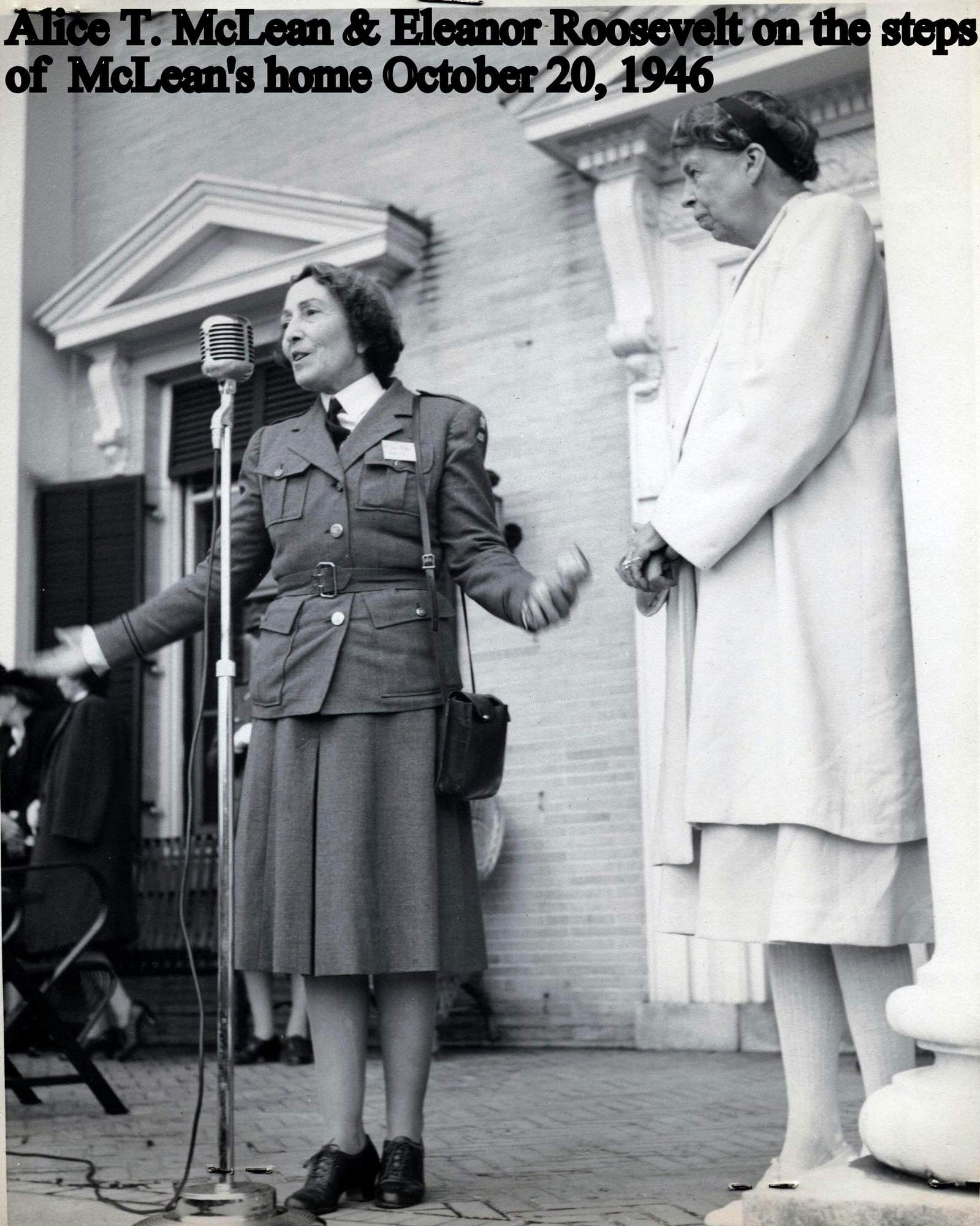
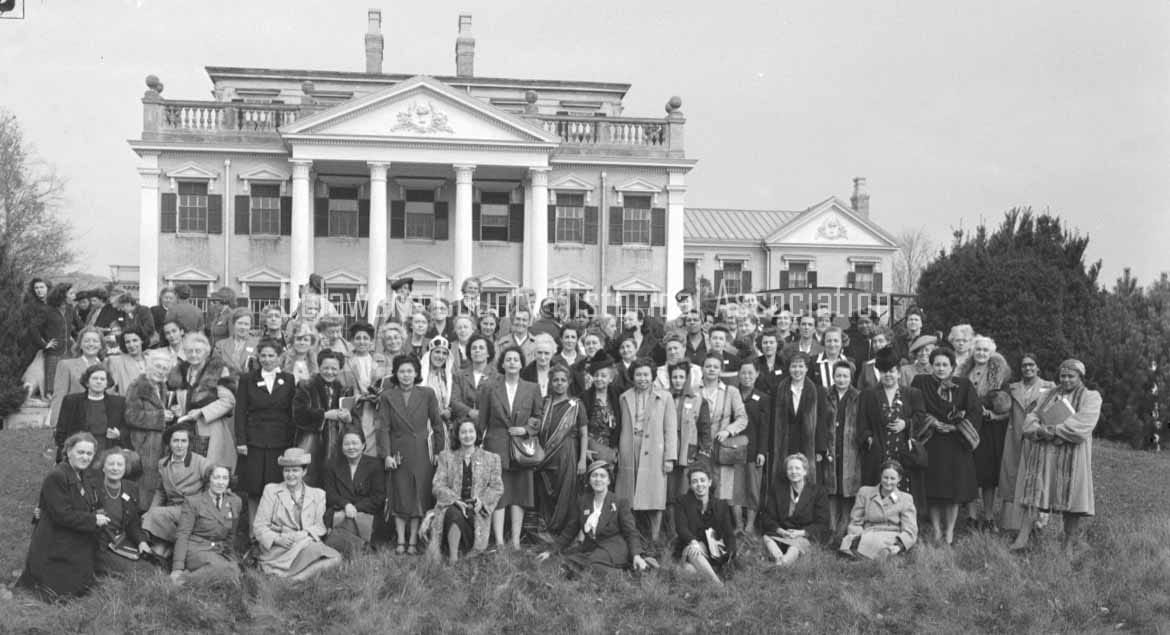
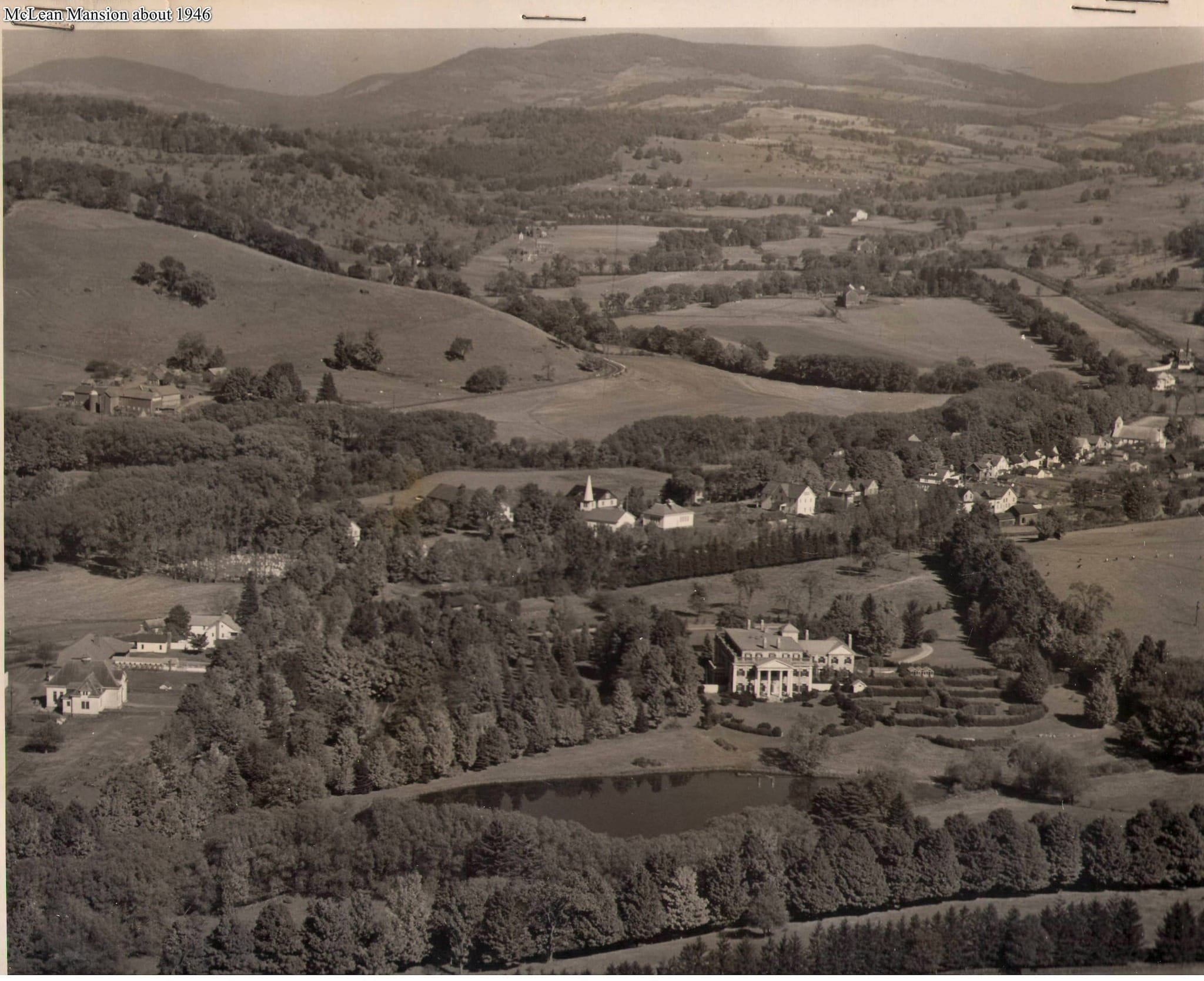
The layers are the point. The house does not erase its history — it holds it. The bedroom washed in golden yellow. The portraits of Eleanor Roosevelt on the walls. The photograph from October 20, 1946, with two hundred women on the front lawn. McLean's Bridge — the stone arch James McLean built across the West Branch in 1900 — still crosses the river nearby, though it is public infrastructure and no longer part of the estate.
What follows is the record as we know it, told chapter by chapter.
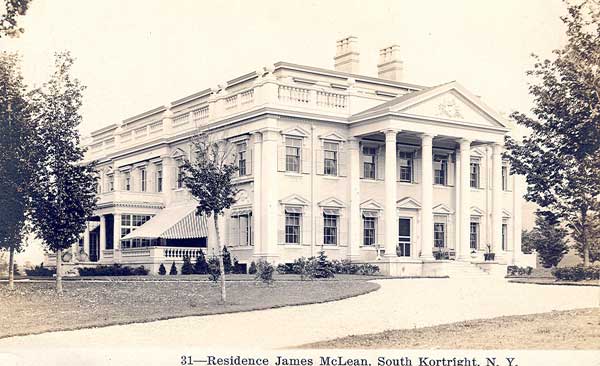
Between 1912 and 1914, the copper magnate James McLean raised this house on a hill above the West Branch of the Delaware. McLean had made his fortune at Phelps Dodge — one of the largest copper mining and manufacturing companies in the United States — and he spent part of it building an estate in the western Catskills that would be a regional landmark by its first decade.
The house is Georgian and Gilded-Age in character: red brick, granite fireplaces, original copper roof, and rooms of eighteen-foot ceilings. The architect's name has not yet come down to us. James McLean called the river-meadow land around the lake Riverside Farm. By the 1930s, the name Belle Terre — and later Ashridge — had extended to the whole estate.
In the summer of 1900, McLean had already built the ornate stone bridge across the West Branch that bears the family name — an investment of some twenty thousand dollars in cut stone and wrought iron, built in concert with the Andrews estate on the far bank. It crosses the river still, adjacent to the present estate, though it is now public infrastructure and not part of Ashridge.
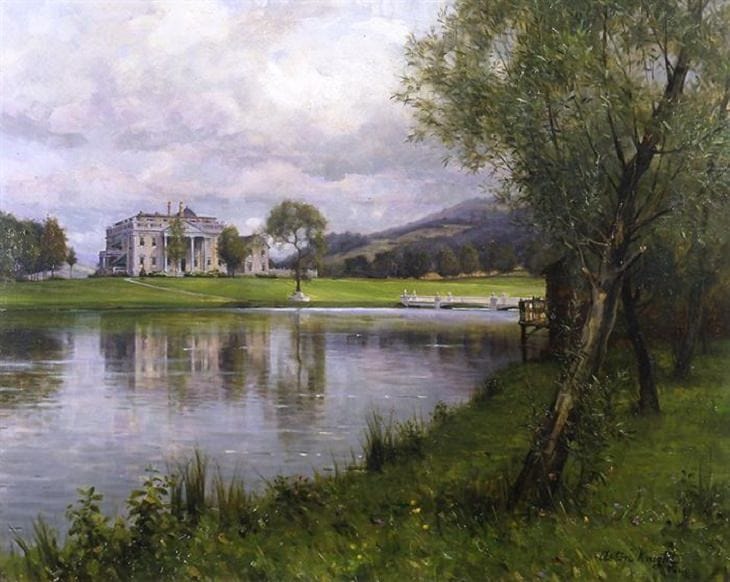
In the summer of 1915, the painter Louis Aston Knight came to South Kortright to record the new estate. The mansion was just months complete. The copper roof was still bright. Knight — son of the American master Daniel Ridgway Knight, trained in Paris, known for his luminous river and garden scenes — gave his painting the name James McLean used for the river-meadow land: Riverside Farm — South Kortright, N.Y.
The painting is both a document and an artwork: the earliest known visual record of the estate as its builder intended it to look. It hangs in the record of the estate's first season.
James McLean's daughter, Alice Throckmorton McLean, became the estate's steward, strategist, and most consequential occupant. In January 1940 she founded the American Women's Voluntary Services — the largest civilian women's organization in American history, three hundred and twenty-five thousand strong at its wartime height. She opened it to every woman, "regardless of race, color or creed," and women of color in New York were among the first to join.
From the mansion — then known as Belle Terre — she ran an operation that stretched from the kitchen gardens to the national stage. In September 1940, as part of that work, she opened the estate to the surrounding community for an enormous barbecue — the event local historians call the McLean BBQ. Photographs of that day are held by the Delaware County Historical Association. In 1942, Dr. Mary McLeod Bethune and Mrs. T. Arnold Hill were elected to the AWVS national board. Alice McLean does not appear in most general histories of the period. This site exists in part to correct that.
From October 13 to October 20, 1946 — in the closing weeks of the first year after the war — two hundred women from fifty-four nations gathered at Ashridge, formerly Belle Terre, for ten days. They came at the invitation of Alice McLean and the urging of Eleanor Roosevelt, then drafting what would become the Universal Declaration of Human Rights. Among the delegates were some of the most prominent women of their time.
They were housed in the mansion, the farmhouse, and the outbuildings. They deliberated in the great hall. On October 20, Eleanor Roosevelt closed the International Assembly of Women on the front steps of the mansion. The day ended in fireworks over the lake. Their findings went to the United Nations.
It was, and remains, the most significant event in the estate's history. The house has not forgotten it.
Two years after the Assembly, Alice McLean founded the International Valley Foundation — a philanthropic organization that operated from within the estate itself. She ran it from her own drawing room, with seventy contemporary Chinese paintings on the walls and the actor Will Geer living in the Carriage House.
The Foundation extended the estate's life as a gathering place through the late 1940s and into the 1950s, continuing the work Alice McLean had begun with the Assembly and with the AWVS. It is the third and least-documented chapter of her public life — a chapter this site is committed to recovering.
Following Alice McLean's death and the winding down of the International Valley Foundation, the estate passed through a series of philanthropic and institutional stewards. For several decades it was adapted for residential institutional use — the identity and details of which we are in the process of documenting.
This era of the estate's history is a significant one: it accounts for the institutional-scale infrastructure — commercial kitchen, commercial laundry, extensive power and septic capacity — that makes the campus as capable as it is today. The building was kept in operation, if not at its original residential grandeur, and the bones of what James McLean built survived.
By 2015, the institution had closed and the house stood empty.
In 2017, the artist Hunt Slonem found the house. Slonem — painter of bunnies, butterflies, and birds, and a restorer of grand American houses across the Northeast — bought Belle Terre, gave it back its color, and made it his private residence. The chandeliers, carpets, wallpapers, and hand-applied wall colors he chose remain: layered onto original Zuber papers, granite fireplaces, and Gilded-Age plasterwork, with window treatments throughout the principal rooms. To walk through the house is a masterclass in color and light.
For the bedroom of eighteen-foot ceilings he chose a golden yellow. For Alice McLean — whose gatherings had once filled these rooms — he painted Eleanor Roosevelt: several portraits, made for these walls, and still among them. The rabbits that run across the paper and the fabrics are his own, drawn for these specific rooms.
It was a restoration that understood its subject: Slonem did not give the house a new identity. He gave it back the one it had.
Further reading: Slonem's tour of the house for the series Home Matters (video) · Ashridge is featured in Spirited Homes (Abrams).
The campus opens again under its first name — the name Alice McLean used, the name the house knew before the institutional decades, the name that connects it most directly to James McLean's original intent and to the gathering-place it became under his daughter.
Ashridge, formerly Belle Terre, is now available for film productions, photography, retreats, weddings, and private whole-estate gatherings. The history does not recede — it is part of what you come for. The house that held the International Assembly of Women, that was painted by Louis Aston Knight, that hosted Eleanor Roosevelt on its front steps, is open again. To one gathering at a time.
Return to the homepageTen days, fifty-four nations, one house in the western Catskills. The full account.
Read October 1946Founder of the AWVS. Host of the Assembly. Daughter of the builder. The life behind the history.
Read her storyThe painter who recorded the estate in its first season, and what that painting tells us about the house as built.
Read about KnightPhotographs, postcards, documents, and primary sources from the Delaware County Historical Association and beyond.
View the archiveAshridge is available for film productions, retreats, weddings, and private gatherings. The history is part of what you come for.
Inquire