Daughter of a copper merchant. Founder of the American Women's Voluntary Services. Convener of the International Assembly of Women. Builder of the International Valley.
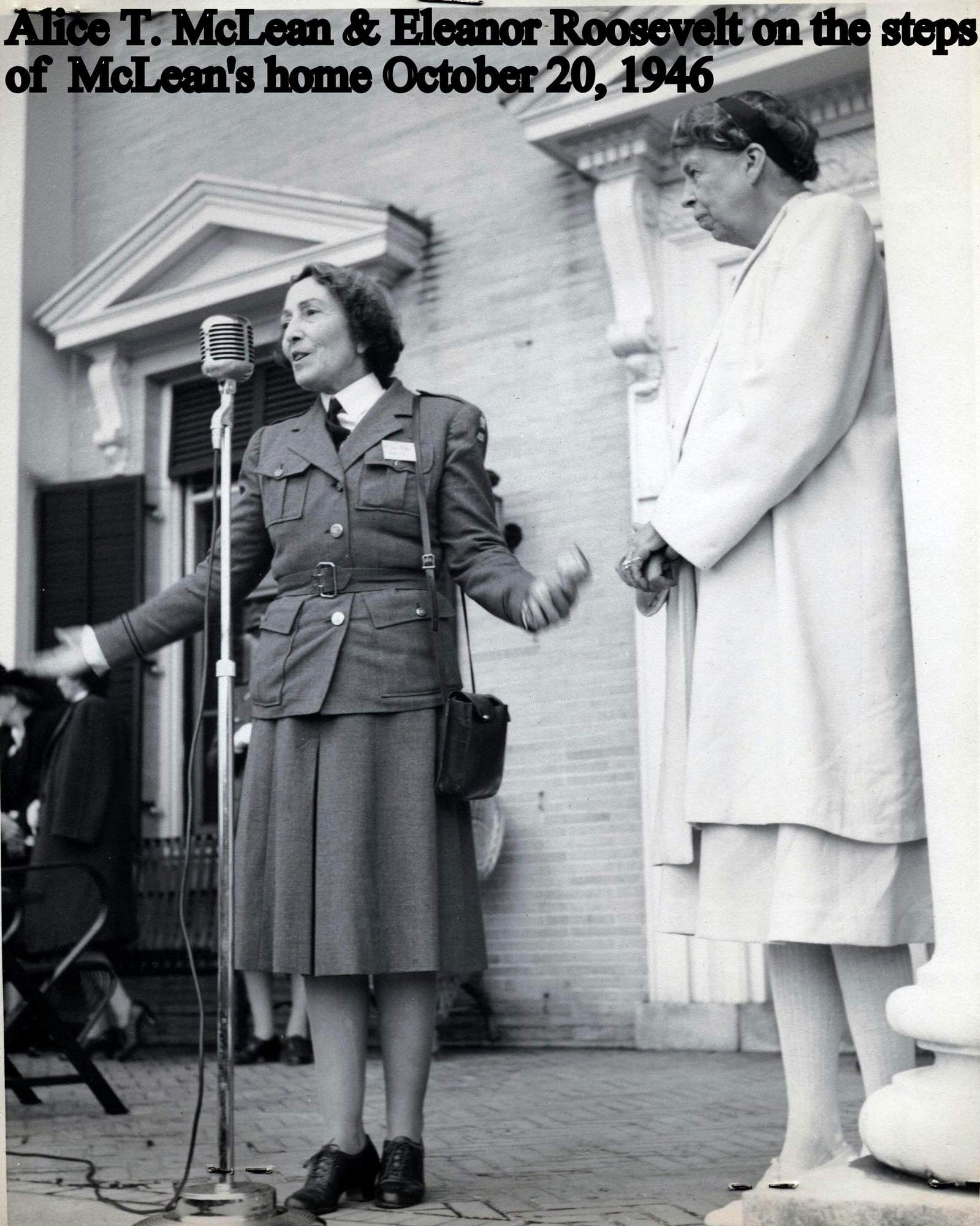
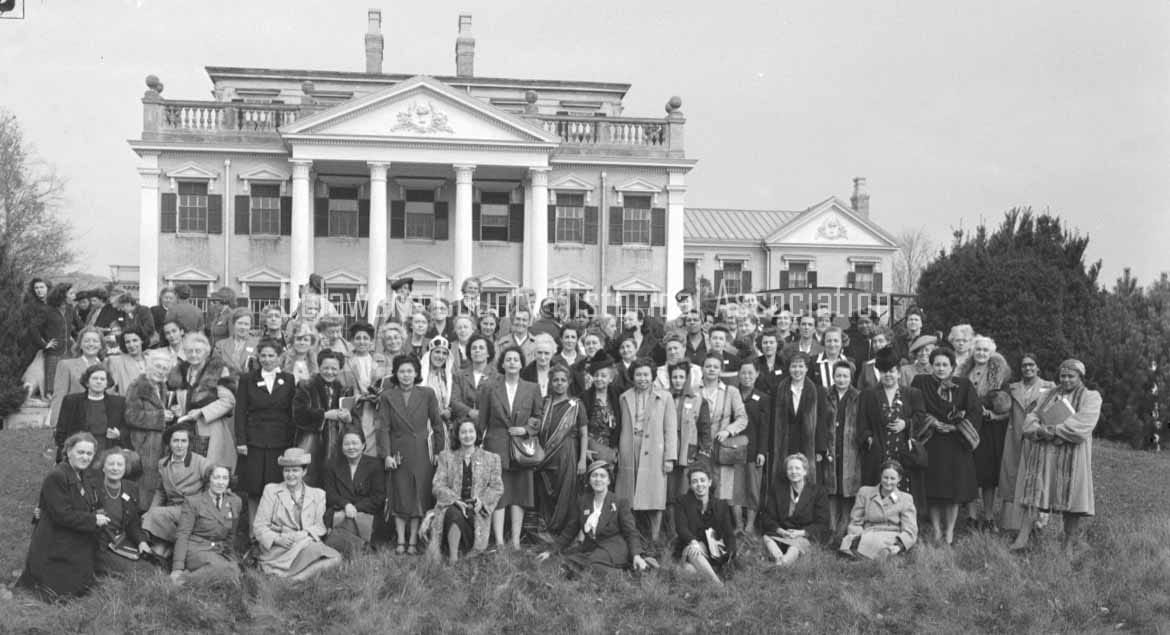
Alice McLean & Eleanor Roosevelt · Ashridge · October 20, 1946 Photograph by Bob Wyer · Delaware County Historical Association
A Life
1886 — 1968
I
Daughter of Copper
Daughter of Copper
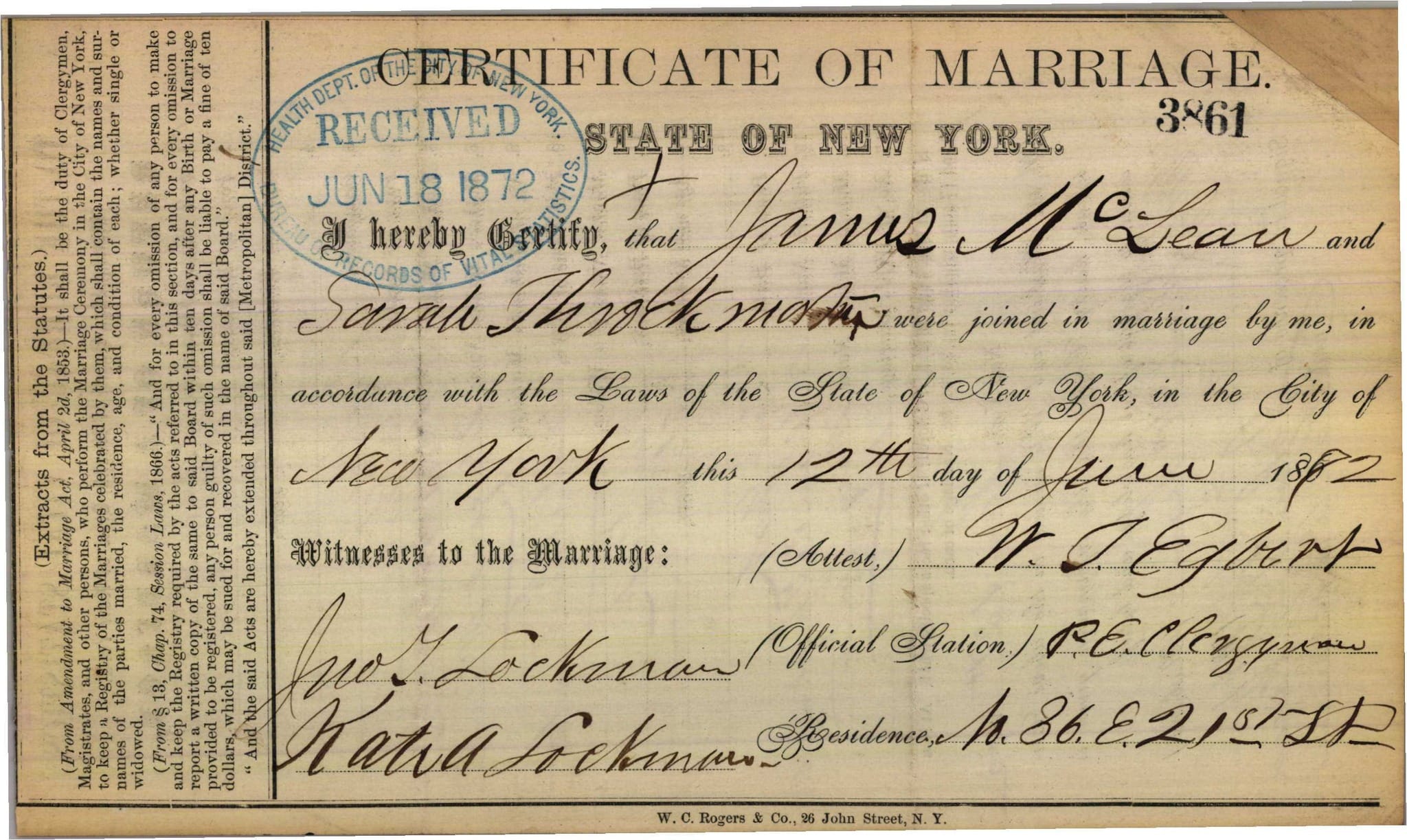
Alice Throckmorton McLean was born in 1886, the youngest of three daughters of James McLean, a New York copper and metals merchant, and his wife Sara Throckmorton. Her father had been born in New York in December 1846 to Edward W. McLean — a Scottish immigrant naturalized in the United States — and Margaret McFarland. Her mother, Sara, also born in New York, was the daughter of William S. Throckmorton and Mary Sexton. James and Sara had married in New York City on the twelfth of June, 1872, with John T. and Kate A. Lockman as witnesses. The Lockman family would remain close to the McLeans for the next half-century.
By the time Alice was born the family had become prosperous. James McLean's metals business, conducted from offices on John Street in lower Manhattan, would over the next two decades carry him into senior association with what became Phelps, Dodge & Company — the great American copper concern of the late nineteenth and early twentieth centuries. The family kept a Manhattan house at 16 West 55th Street, a fashionable midtown address, and traveled to Europe as the children of the American copper era did.
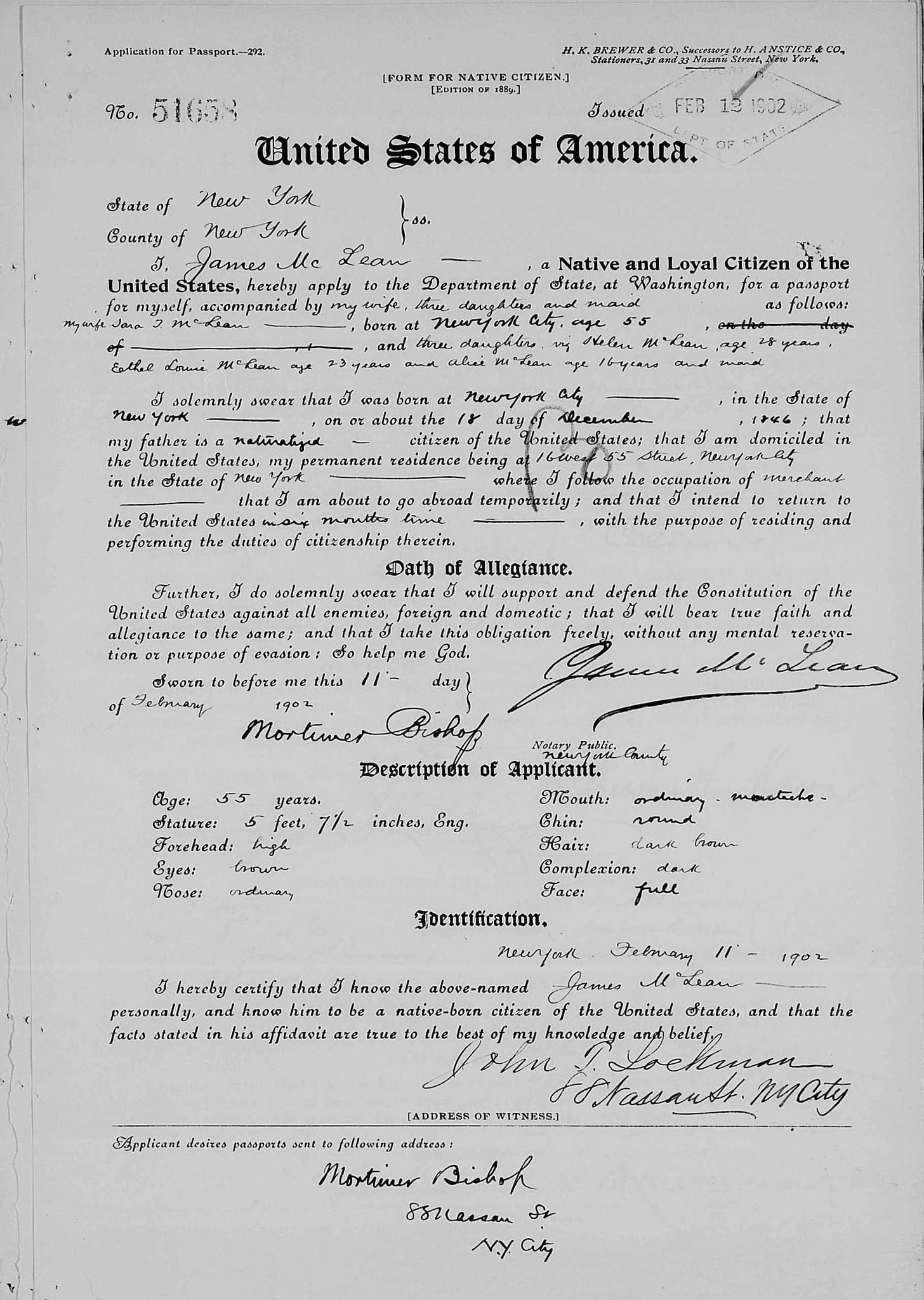
A surviving passport application of February 1902 records the family departing New York for an extended visit abroad: James, then fifty-five years old, with his wife Sara — listed at her own age of fifty-five — and their three daughters Helen (twenty-eight), Ethel Louise (twenty-three), and Alice (sixteen), accompanied by a maid. James gave his occupation as merchant, his height as five feet seven and one-half inches, his hair dark brown, his complexion dark, his face full.
Application for Passport No. 51653
James McLean, witnessed by John T. Lockman · February 11, 1902
National Archives · Department of State Records
The document is a small revelation. It places Alice, at sixteen, on a transatlantic crossing with her sisters and parents. It gives us, in her father's own hand, the family's social geography: a Manhattan address, a metals trade, daughters in late adolescence and early adulthood, a maid in tow. It is also a quiet document of how the McLean fortune had translated, by the turn of the century, into the standard equipment of the American haute-bourgeoisie — a passport, a household, the assumption of travel.
Alice would inherit much of this. What she did with it was something else.
II
The Estate
The Estate
Between 1912 and 1914, James McLean built the mansion at South Kortright, New York, that would become the center of his family's life and the focus of his youngest daughter's mature work. Brick without, granite within — the stone used for the fireplaces and the grander rooms; the roof, befitting the family trade, was hammered copper. The architect's name has not yet come down to us. In 1900, James McLean had built an ornate stone bridge across the West Branch — some twenty thousand dollars of cut stone and wrought iron — in concert with the Andrews estate on the far bank. The bridge still carries the river road through South Kortright; it stands adjacent to the present estate but is no longer McLean — or Ashridge — property.
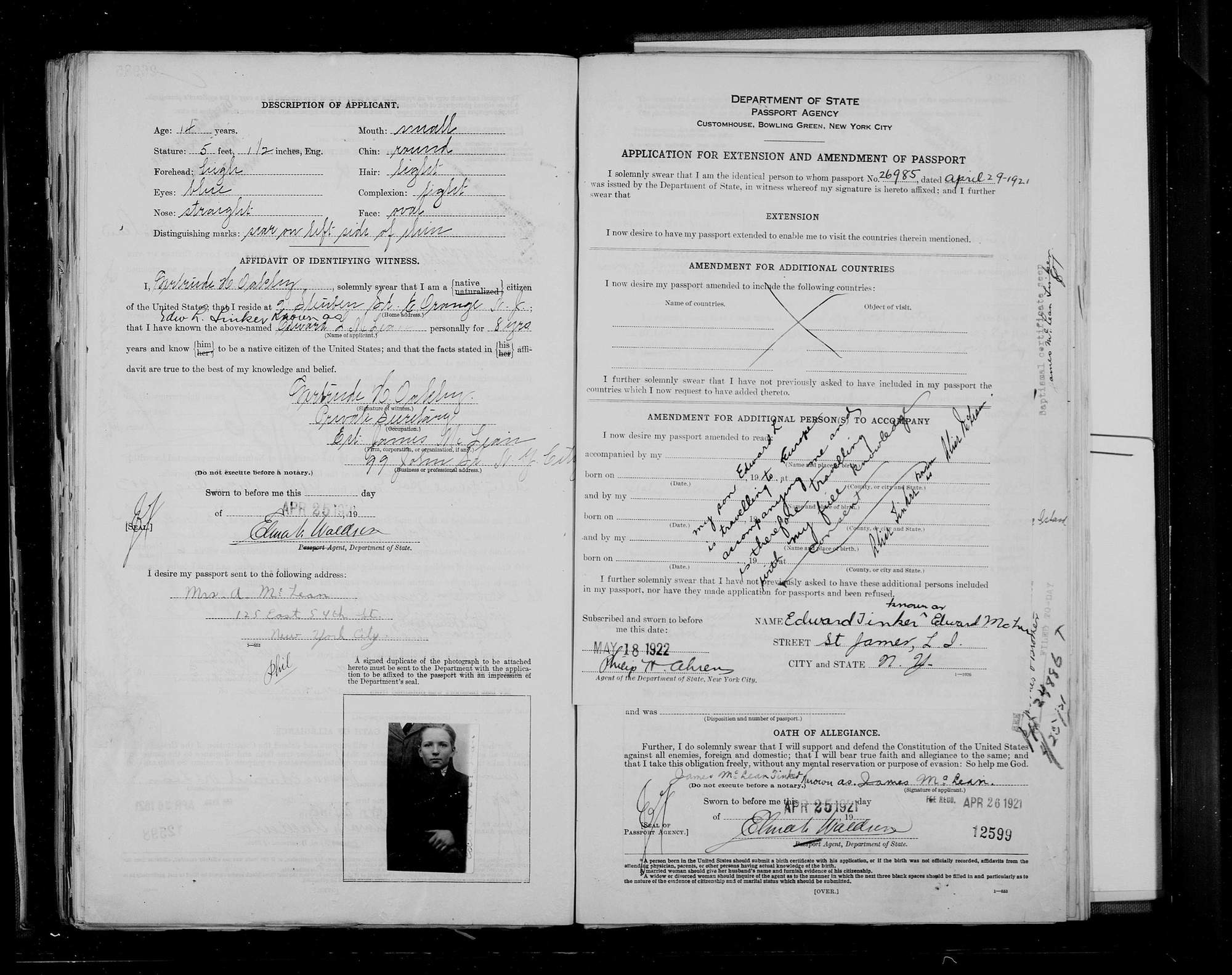
James McLean died in 1920. Alice, by then in her early thirties, had married a Mr. Tinker and was living at least part of the time in St. James, Long Island. The estate at South Kortright passed through the administration of James's estate offices at 99 John Street in Manhattan. By the early 1920s, Alice was traveling on her own passport, witnessed in 1922 by the McLean family's private secretary Gertrude H. Oakley.
Certificate of Marriage No. 3861 · James McLean and Sarah Throckmorton
New York City · June 12, 1872
Passport extension application · Alice Tinker (McLean) · age 35
New York · May 16, 1922
Within a few years Alice had returned to her family name and was the primary steward of the South Kortright property. She began to think of it not as a private retreat but as an instrument. Her father had called the river-meadow acreage Riverside Farm, the name preserved in the Knight painting of 1915; by the late 1930s Alice had extended the word Ashridge to the whole estate, with International Valley reserved for what she hoped it might become.
III
The AWVS
The AWVS
In January 1940 — nearly two years before the United States entered the Second World War — Alice McLean founded the American Women's Voluntary Services. Her model was the British Women's Voluntary Services, established the year before in response to the threats Britain saw coming. McLean's hypothesis was that American women, given a structure, would mobilize to meet the war already underway in Europe before the country itself recognized that it would have to join.
She was right. By the time the United States entered the war in December 1941, the AWVS had chapters across the country. At its wartime height it counted approximately three hundred and twenty-five thousand members, trained in:
— ambulance driving and motor transport;
— radio and cryptography;
— firefighting and air-raid response;
— emergency medical care;
— mobile-kitchen operation and disaster feeding;
— photography and aerial spotting;
— and the dozen other domestic-front technical specialties the war would require.
Members sold over a billion dollars in war bonds. They drove ambulances after East Coast bombings that, mercifully, did not come. They staffed wartime canteens. They trained, in number, more American women in technical and operational specialties than any other civilian organization of the period.
The choice McLean made at the AWVS's founding meeting in January 1940 — the one she returned to repeatedly when asked about the organization in later years — was that it would be open to women regardless of race, color, or creed. Women of color in New York were among the first to join. Chapters were integrated from their first meetings. This was 1940, in a country in which the armed forces were still segregated and would remain so until 1948. The AWVS was, at its scale, the largest racially integrated American women's organization of the wartime period, and almost certainly of any period to that date.
McLean ran it from her father's house at South Kortright for most of the war. She spent much of her own fortune to keep it running when federal funding did not arrive. By the closing of the war the AWVS was, in its category, the most consequential civilian women's organization in American history. Most general histories of the period do not mention it.
In September 1940, McLean hosted a large community barbecue at her South Kortright estate — the McLean BBQ — inviting neighbors from across the county as part of her wartime civic work. Photographs of that day are held by the Delaware County Historical Association.
IV
October 1946
October 1946
International Assembly of Women · Ashridge · October 20, 1946
Photograph by Bob Wyer · Delaware County Historical Association
With the war over and the AWVS winding down, McLean turned to what came next. In partnership with Eleanor Roosevelt, then chair of the new United Nations Commission on Human Rights and a year into the work that would produce the Universal Declaration of Human Rights, McLean convened the International Assembly of Women at Ashridge from October 13 to 20, 1946. Two hundred women from fifty-four nations came. They worked in the coach house, in the village schools, and on the lawns of the estate for ten days. They sent their findings to the United Nations.
McLean opened the closing day on October 20 from the front steps of the mansion, in her AWVS uniform, at a microphone. Eleanor Roosevelt stood beside her in a pale long coat. Bob Wyer made the photograph that now anchors this project. The day closed with fireworks over the lawn.
The Assembly was, in McLean's own framing, the first formal expression of what she had been calling International Valley — the long-running project to use her father's estate, her own connections, and her family's money to convene the world's women in service of a peace whose foundations the war had only just made possible to imagine. There is a separate piece on this site about those ten days.
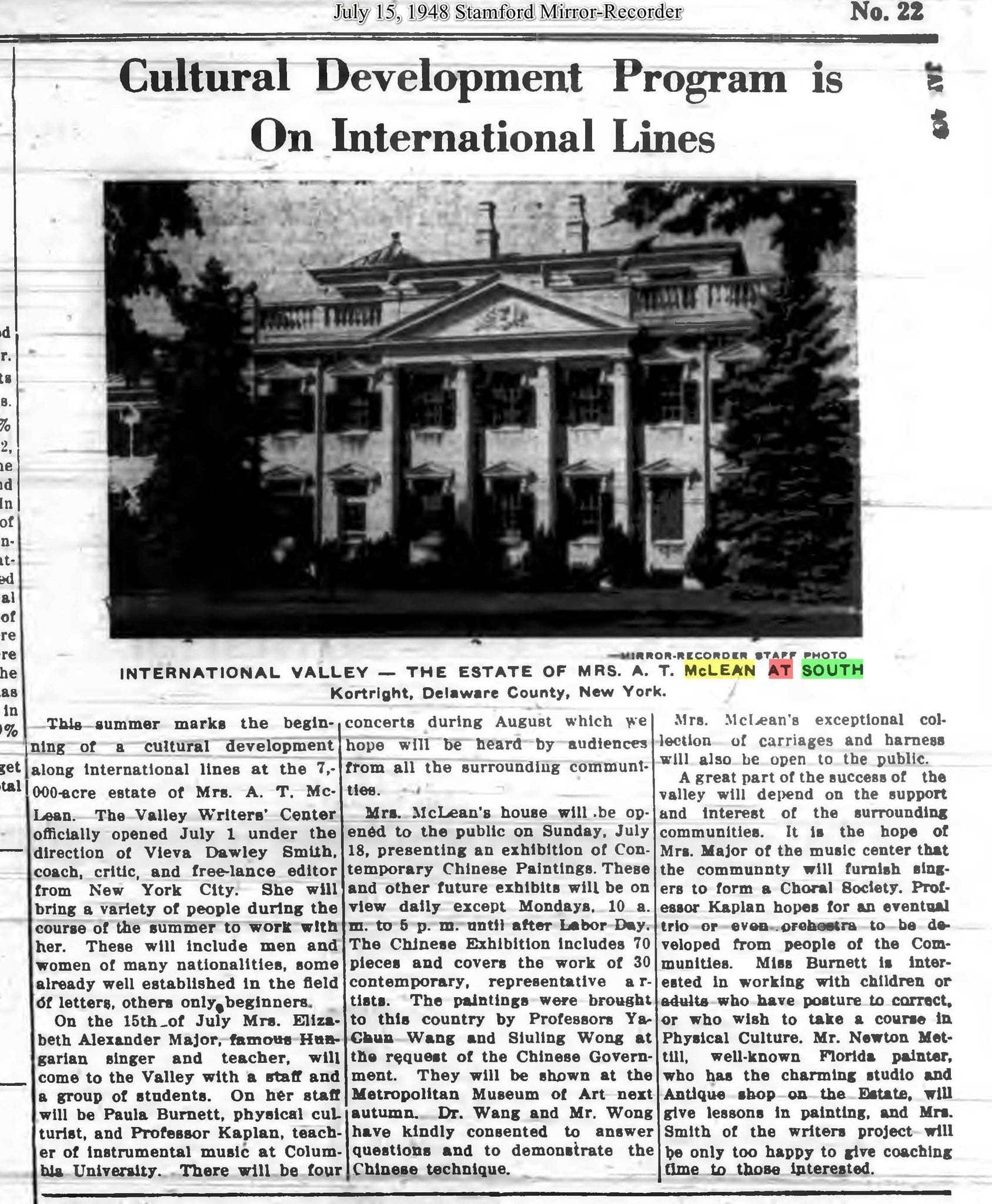
The standard short biography says that McLean gave Ashridge away in 1948 and left South Kortright. The standard short biography is wrong — or at least seriously incomplete. What she did in 1948 was found the International Valley Foundation and put the estate under its stewardship, with herself continuing to direct the cultural program from her own house. The Stamford Mirror-Recorder reported the opening of the program on July 15, 1948.
"Cultural Development Program is On International Lines"
Stamford Mirror-Recorder · July 15, 1948
The program the article describes is remarkable. The Valley Writers' Center opened July 1, 1948, under Vieva Dawley Smith — a New York editor and critic — with rotating residencies for established and emerging writers. A music center opened a fortnight later under the direction of Mrs. Elizabeth Alexander Major, the Hungarian-born singer and teacher, with a staff that included Professor Herman Kaplan of Columbia University teaching instrumental music. Four concerts were planned for August. A painting program was run by LaMont Warner and Newton Mettill, the latter a Florida painter with a studio and antique shop on the estate. McLean's house was opened to the public on Sunday, July 18, 1948, with an exhibition of seventy contemporary Chinese paintings by thirty artists, brought to the United States by Professors Ya-Chun Wang and Siuling Wong at the request of the Chinese Government. The paintings were on view in McLean's drawing room, daily except Mondays, ten in the morning to five at night, until after Labor Day. They went, that autumn, to the Metropolitan Museum of Art.
At the opening salon McLean greeted the novelist Fannie Hurst; the Chinese Consul General Pasheng Yen and his family attended; Hazel Nielsen of the National Society of the Daughters of the American Revolution attended. The article noted, dryly, that "a great part of the success of the valley will depend on the support and interest of the surrounding communities."
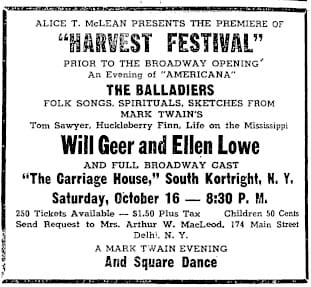
Three months later, on Saturday October 16 — almost certainly the same year, 1948 — McLean's Harvest Festival brought the actor Will Geer and the singer Ellen Lowe, with the full Broadway cast and a group of folk musicians billed as The Balladiers, to the Carriage House for an evening of Mark Twain sketches, folk songs, and spirituals. The advertisement promised "a Mark Twain evening and square dance," presented prior to the show's Broadway opening. Tickets were $1.50 plus tax, fifty cents for children, available through Mrs. Arthur W. MacLeod at 174 Main Street, Delhi, New York.
Advertisement for the Harvest Festival
The Carriage House, South Kortright · October 16, c. 1948
Local Catskill press
Will Geer in 1948 was at the height of his pre-blacklist career. He had been on Broadway since the late 1920s, had created Mr. Mister in Marc Blitzstein's The Cradle Will Rock, had toured the federal work camps with Woody Guthrie and Burl Ives in the 1930s. He would be blacklisted in 1951 for refusing to testify before the House Un-American Activities Committee. That McLean was producing him at South Kortright in 1948, two years before the blacklist closed the major American stages to him, says something specific about the company she kept and the politics that ran beneath the philanthropy. She was a copper heiress and a society lady; she also patronized the actor Hollywood would shortly try to destroy.
The International Valley, in other words, was not a vague philanthropic gesture. It was a working multidisciplinary arts program — writing, music, painting, theater, exhibition — with substantial international content and a politically progressive cast, operating at scale on a private estate in the western Catskills in the second half of the 1940s.
How long it ran in its first form is not yet clear to us. The estate eventually passed out of the foundation's active program; by 1992 the mansion was in use as a residential drug-and-alcohol-treatment facility operated by Phoenix House, which kept the building maintained and inhabited through the long American mid-century. The years between McLean's 1948 founding of the foundation and the Phoenix House transition are an open archival question we are working on.
VI
After
After
Alice McLean died in 1968, at eighty-two. The Universal Declaration of Human Rights, whose drafting Eleanor Roosevelt had been leading on the days of the 1946 Assembly, was twenty years old. The American Women's Voluntary Services, which had at its height counted a third of a million American women in its ranks, had been formally dissolved years earlier.
She does not appear in most general histories of the period. The AWVS is mentioned in passing in the better wartime studies and not at all in many. The International Assembly of Women does not appear in most. The International Valley is a footnote known mostly to historians of the Catskills and to families whose grandmothers attended one of its summer programs.
"A great part of the success of the valley will depend on the support and interest of the surrounding communities."
Stamford Mirror-Recorder · July 15, 1948
Reporting on the opening of the International Valley program
Recovering her, properly, is one of the things this project is for.
The photograph of Alice McLean at the microphone with Eleanor Roosevelt
was made by Bob Wyer on the afternoon of October 20, 1946.
A Note on Sources
This account draws on the McLean family marriage and passport records preserved at the National Archives; the contemporary reporting of the New York Times, the Stamford Mirror-Recorder, and The Oneonta Star; Eleanor Roosevelt's My Day columns of October 12 and October 23, 1946; the institutional histories of the American Women's Voluntary Services and the United Nations Commission on the Status of Women; the catalog research of Rehs Galleries on Louis Aston Knight; and the Brownstoner Upstate property history by the architectural historian Suzanne Spellen. We are particularly grateful to the Delaware County Historical Association for the survival of the Bob Wyer photographic archive.
The biographical record between 1948 and 1968 — including the dates of Alice McLean's departure from South Kortright and the wind-down of the International Valley Foundation — remains partial. If you hold materials related to McLean, to the AWVS, or to the International Valley, please write to archive@ashridge.estate.